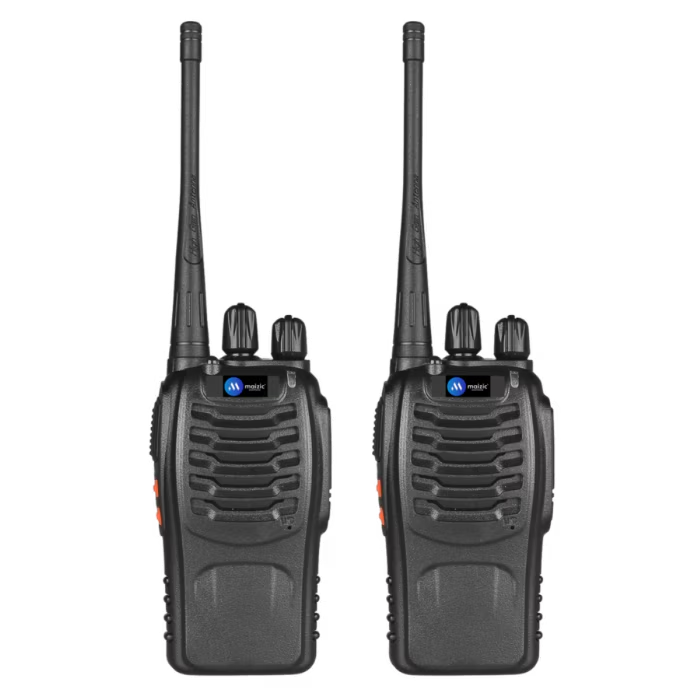
A Walkie Talkie is a portable two-way wireless communication device designed to provide instant voice communication between users over short to medium distances without relying on mobile networks. It is widely used by security personnel, police, military units, industrial teams, event management staff, emergency responders, construction crews, warehouse operators, and field technicians for quick, reliable, and coordinated communication. Unlike mobile phones, walkie talkies offer push-to-talk (PTT) communication, allowing users to speak to individuals or groups immediately at the press of a button, which makes them highly effective for operational environments where speed, simplicity, and reliability are essential.
Walkie talkies operate on designated radio frequencies such as VHF (Very High Frequency) or UHF (Ultra High Frequency) bands, depending on the intended application and terrain. VHF models are generally suitable for open outdoor areas with fewer obstructions, while UHF models are preferred in urban, indoor, or built-up environments because they perform better around buildings and structures. Modern walkie talkies are available in analog or digital variants, with digital models offering advantages such as clearer audio, better noise reduction, improved privacy, text or status features, and more efficient spectrum usage. Many units support multiple programmable channels, enabling separate teams or departments to communicate on dedicated channels while maintaining operational control.
A professional walkie talkie is built for rugged field use and generally includes features such as a high-capacity rechargeable battery, antenna, speaker microphone, LCD display (in some models), emergency alert function, VOX hands-free operation, scan mode, channel lock, keypad lock, battery saver, and low-battery indication. Security and industrial-grade devices are often designed with durable polycarbonate or ABS housings, dust and splash resistance, and compatibility with accessories such as remote speaker microphones, earpieces, belt clips, chargers, and programming cables. Depending on the model and terrain, communication range can vary from 1 km to 10 km or more, although actual performance depends on antenna design, transmission power, building density, and line-of-sight conditions.
Walkie talkies are especially valuable in environments where network availability is poor, immediate group communication is needed, or mission-critical coordination is required. In defense, policing, disaster response, and industrial safety operations, they provide a dependable communication backbone that remains operational even when mobile networks are congested or unavailable. Their simple one-button operation, rugged design, and long battery endurance make them suitable for continuous shift-based use, outdoor patrols, event control, rescue work, and plant operations. Overall, the walkie talkie remains one of the most practical and trusted portable communication tools for real-time team coordination, emergency communication, and field command support.
| Item | Walkie Talkie |
| Function | Portable two-way wireless voice communication |
| Band | VHF / UHF |
| Technology | Analog / Digital |
| Output Power | 1W to 5W |
| Channels | 16 to 128 channels |
| Range | Up to 1–10 km+ (depending on terrain and model) |
| Battery | Rechargeable Li-ion / NiMH |
| Backup | Approx. 8–18 hours |
| Features | PTT, scan, VOX, emergency alarm, low-battery alert |
| Construction | Rugged handheld body |
| Application | Security, police, army, industrial, event and emergency communication |