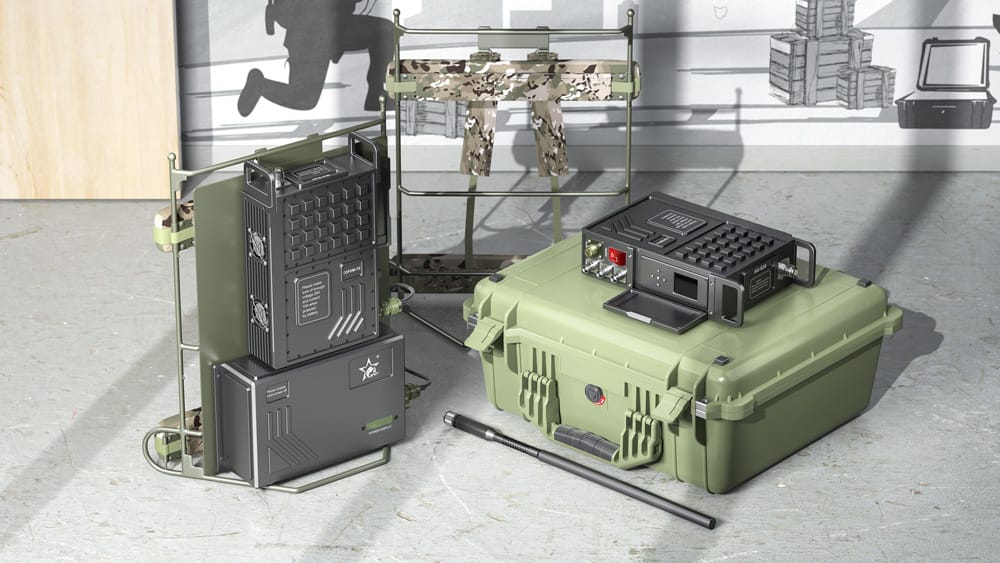
A Body-Worn Wireless Video Transmitter is a compact portable transmission device designed to wirelessly send live video, audio, and optionally data/telemetry signals from a body-mounted camera system to a remote receiver, command post, monitoring station, or recording setup. It is commonly used in defense, law enforcement, tactical surveillance, VIP protection, special operations, disaster response, industrial inspection, event broadcasting, and field journalism where real-time mobile video transmission is required without restricting operator movement. The unit is typically worn on the body, tactical vest, belt, harness, backpack, or integrated with a wearable camera assembly, allowing personnel to stream live footage from the field while remaining mobile and hands-free.
These transmitters are generally based on digital wireless video transmission technologies such as COFDM / DVB-T or similar robust mobile RF platforms, which are selected because they perform reliably in non-line-of-sight (NLOS), urban, and high-mobility environments. A body-worn transmitter captures the video feed from a compact camera—through HDMI, SDI, AV, or dedicated camera interface depending on the system—and encodes it using H.264 / H.265 / HEVC compression for efficient wireless transmission. Many systems support full HD 1080p video, embedded or external audio, adjustable RF output power, configurable bandwidth, encryption, and frequency agility so that the transmitter can be deployed in varied operational scenarios. Because the equipment is worn by personnel, emphasis is placed on low weight, compact size, low power consumption, and rugged construction.
A body-worn wireless video transmitter is particularly valuable in tactical and public-safety operations, where commanders need a live first-person view from the field for better situational awareness and decision-making. It can be used by police teams, special forces, bomb disposal units, emergency responders, covert surveillance teams, fire services, industrial inspection crews, and broadcast operators. In addition to live video, advanced models may also support return control links, telemetry, serial data, GPS tagging, AES encryption, multi-camera integration, and compatibility with body-worn cameras or helmet cameras. Depending on frequency band, antenna configuration, terrain, and receiver type, transmission may cover short-range urban monitoring to several kilometers in open or supported RF conditions.
Modern body-worn transmitters are engineered to withstand field conditions such as vibration, movement, dust, moisture, and repeated operational handling. The enclosure is typically made from lightweight metal alloy or ruggedized polymer, with sealed connectors, heat-managed electronics, and secure mounting provisions. Power is usually supplied from an external battery pack, wearable battery, or DC source, enabling prolonged operation during patrols, surveillance, and tactical missions. Overall, the Body-Worn Wireless Video Transmitter is an important mobile surveillance and communications component that enables real-time field video intelligence, remote monitoring, and improved command visibility while keeping the operator agile and unobstructed.
| Item | Body-Worn Wireless Video Transmitter |
| Function | Live wireless transmission of body-camera video and audio |
| Technology | COFDM / digital wireless RF video transmitter |
| Video Support | SD / HD / Full HD up to 1080p |
| Inputs | HDMI / SDI / AV / dedicated camera interface |
| RF Power | 50 mW to 5 W (model dependent) |
| Frequency | UHF / tactical RF bands / 2.4 GHz / 5.8 GHz (model dependent) |
| Compression | H.264 / H.265 / HEVC |
| Security | AES encryption optional / model dependent |
| Mounting | Body / vest / belt / tactical gear mounted |
| Power | External battery / DC supply |
| Application | Police, military, surveillance, tactical operations, live monitoring |