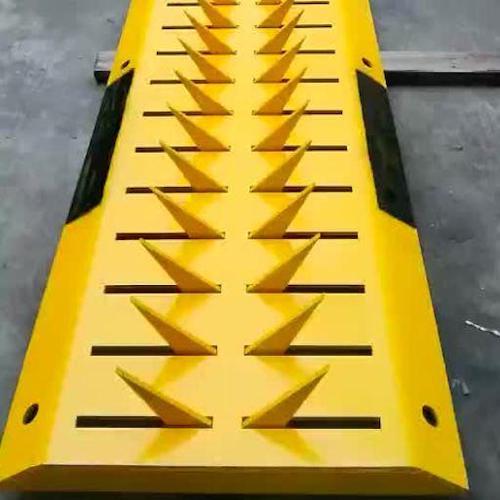
A Tire Killer Barrier is a high-security vehicle access control system designed to stop unauthorized, wrong-way, or hostile vehicles by puncturing and deflating their tyres when they attempt to pass through a protected entry or exit point. It is commonly installed at military establishments, government complexes, correctional facilities, embassies, airports, ports, industrial plants, data centers, VIP compounds, toll plazas, and other high-security premises where vehicle movement must be tightly controlled. The system is engineered as a road-embedded spike mechanism that acts as a powerful physical deterrent against forced entry, tailgating, reverse intrusion, and unauthorized access through controlled gates and checkpoints.
The tire killer barrier consists of a heavy-duty steel housing installed flush with or slightly above the road surface, incorporating a row of hardened steel spikes / teeth mounted in a directional arrangement. In normal authorized traffic flow, the system is either kept in the safe passage position or configured for one-way movement. However, when a vehicle attempts to move in the prohibited direction or tries to breach the access point, the sharp spikes penetrate the tyres and rapidly deflate them, immobilizing the vehicle and preventing further movement. Depending on the design, the tire killer can be supplied in manual, semi-automatic, or fully automatic electro-mechanical / hydraulic variants, and can be synchronized with boom barriers, bollards, sliding gates, crash-rated blockers, RFID access systems, ANPR cameras, and security control systems.
Modern tire killer barriers are manufactured using heavy-duty structural steel, anti-skid top plates, corrosion-resistant finishes, and robust mechanical or hydraulic assemblies to withstand repeated vehicular loads and harsh outdoor conditions. The system is typically available in various widths to suit single-lane, multi-lane, commercial vehicle, or heavy-duty security gate applications. Automatic versions can be operated via push-button control, remote control, access control software, guard cabin panel, loop detector, RFID, or integrated security command systems. Some models include safety interlocks, emergency manual override, limit switches, warning indicators, traffic lights, and sensor integration to improve operational safety and prevent accidental activation during authorized vehicle movement.
A tire killer barrier provides an effective combination of vehicle denial, perimeter protection, traffic discipline, and access control. It is especially valuable at locations where anti-ram security, strict entry/exit management, and immediate response to unauthorized vehicle movement are required. Because the system directly disables the vehicle by damaging the tyres, it offers a rapid and visible method of neutralizing unauthorized access attempts without relying solely on guards or electronic alarms. Overall, the Tire Killer Barrier is a robust and dependable security solution for high-security vehicle checkpoint control, perimeter defense, and controlled vehicular access management.
| Item | Tire Killer Barrier |
| Function | Stops unauthorized / wrong-way vehicles by tyre puncture |
| Construction | Heavy-duty steel road-embedded spike barrier |
| Spike Material | Hardened steel |
| Operation | Manual / semi-automatic / automatic |
| Width | 2 m to 5 m or customized |
| Traffic Control | One-way access / wrong-way vehicle blocking |
| Power Supply | 230V AC for automatic models |
| Control | Push button / remote / RFID / access control |
| Finish | Powder-coated / galvanized corrosion-resistant finish |
| Application | Military, embassies, airports, prisons, industrial and high-security facilities |